Papers
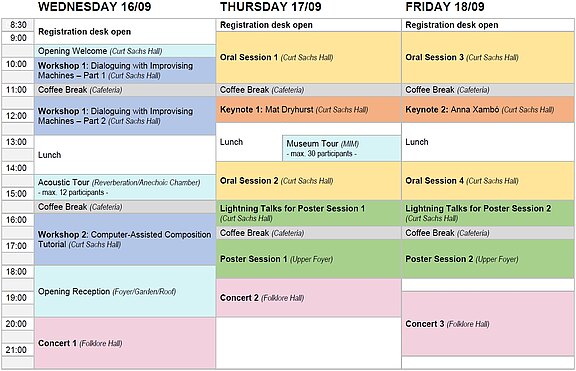
Oral Session 1: The Generative Turn: Rethinking Musicianship and Creative Agency
Papers examining how generative systems and prompt-based platforms reshape musicianship, style, and creative agency.
- Exploring Musical Creativity in the Era of Generative Artificial Intelligence: A Qualitative Inquiry by Peachey & Malloch
- From Indeterminacy to Negotiability: Mediated Musicianship in AI-Assisted Musical Theatre Composition by Wang
- A Large-Scale Sentiment Analysis of AI vs. Conventional Music Videos by Gauvin
- Analyzing Creative Collaboration Discourse in VR Music-Making through Computational NLP by Oehler et al.
- Scaffolding Symbolic Music Generation: An Evaluation of Two Generative MIDI Tools for Novices by Liu et al.
- Do Generative AI Systems Hinder or Encourage Creativity in Music Education? by Erdmann et al.
Oral Session 2: Shared Agency, Performance and Improvisation
Systems and practices where creative control is negotiated between human performers and AI.
- Modeling Relations Between Musical Events in Continuous Time with Transformer Models for Live Co-Improvisational Interactions by Madaghiele et al.
- Real-Time Conditioning Strategies for Shared Agency in AI-Mediated Piano Improvisation by Barrachina et al.
- Scaffolding Off-the-Shelf Text-to-Audio Models for Real-Time Generation in Live Performance by McCallum & Wszeborowska
- Audience Experience of Visual Augmentations for Human-AI Co-Improvisations by Berthaut et al.
- BbLearn: Sculpting Behavioral Clones in Modular Blackboard-Driven Music Systems by Ostermann et al.
Oral Session 3: Instruments, Interfaces and Latent Spaces
Instruments and interfaces that make models playable, from latent space navigation to live coding.
- AFTERnaut: A Multi-Modal Interactive Interface for Embodied Exploration of Neural Synthesis Latent Spaces by O'Donnell & Tanaka
- Wænderer: Repurposing Pre-Trained VAEs as Instruments via Abstract Timbre Space by Thibault & Piazza
- Architecture and Affordances of PLAUD: Performative Latents and Unsupervised DDSP by Kotowski & Font
- Exploring High-Dimensional Spaces: Evaluation of a Node-Based Interface for Neural Audio Synthesis by Auri et al.
- Learned Continuous Synthesis of Quadratic Difference Tone Spectra by Gutiérrez et al.
- Material Biases as Compositional Resources in Text-to-Audio Models by Piazza
Oral Session 4: Listening, Evaluation and Authorship.
Papers regarding how we listen to, evaluate, and attribute AI-generated music, in research, practice, and education.
- Epistemic Inadequacies in Neural Audio Synthesis Evaluation by Ancona
- Tone Deaf: Embedding Amnesia and the Partial Ear of Machine Listening by Sandler
- Whose Intent? Distributed Authorship, Cross-Modal Constraints, and the Limits of Generative Music Systems in Screen Scoring by Bao et al.
- Audio-Side Reinforcement Learning for Symbolic Music Style Adaptation: Extending SMART with Composite Rewards by Tooranian & Sturm
- Find the Neurons, Control the Feature? Selection Strategies for Network Bending Audio Models by McCallum and Grierson
Video talks (pre-recorded, links to video files will be provided below)
Systems and practices where creative control is negotiated between human performers and AI.
- Personalized Gesture-to-Sound Mapping for Accessible Digital Musical Instruments by Molliex & Abassi
Lightning Talks for Poster Session 1
- A Duet of Intelligences: Human–AI Co-Creation in Live Piano Performance by Drobnić & Brandhofer
- On the Music(ai)lly Possible by Ben-Tal
- A local LLM-based system for interactive musical improvisation by Jambois
- Pattern Atlas: Exploring Personal Rhythm Spaces in Ableton Live with a Transformer-Based Variational Autoencoder by Lunt & Trump
- The Good, The Bad and The Ugly: Can Live Coding and Large Language Models Ride Together? by Barbosa & Thibault
- Navigating Density Topologies: Multi-Scale Markov Chains for Real-Time Rhythmic Co-Improvisation by Lorito
- M.E.S.H. – Navigating the latent space through the body-instrument; reclaiming one’s digital traces in the age of large AI models by Moore & Bellefleur Martinez
- Seeing Sound: An Audiovisual Interpretation of Lou Reed’s “Perfect Day” by Hamoud et al.
- Real-Time MIDI Transformer Integration in Pure Data: A Multi-Threaded Architecture for Interactive AI Music Generation by Tahiroğlu et al.
- Emotion Driven Dialogue — A Model of Mediated Musicianship through Biofeedback-Informed Improvisation by Guerra Recas & Jambois
- Where Does Instrumentality Reside in Symbolic Music? A Structural Analysis of a Symbolic-Domain Instrument Classifier by Sawada
- Fast Recognition of Motivic Patterns in Symbolic Music via Lossy Compression by Wilson
- Performing in the Assemblage: Virtuosity in AI-Mediated Environments by Lewis
- ClimaCS: A Multi-genre Dataset of Timed Comments for Music Highlight detection by Guerci & Prétet
- From Prompt to Platform: Agency in a Suno Workflow for Taigi Pop Music by Guo & Chien
- Descriptor-Aware Latent Granular Mosaicing for Real-Time Audio Re-Synthesis by Pichard & Lattner
- MusGU+: Toward a Musician-Centered Evaluation Framework and Discovery Tool for Generative Music AI by Ibáñez-Martínez et al.
Lightning Talks for Poster Session 2
- Loops That Listen: A Voice-Controlled Dynamic Drum Looper with AI Variation by Sandejas et al.
- Leveraging LLM Embeddings for Cross Dataset Label Alignment and Zero Shot Music Emotion Prediction by Liu et al.
- Creative Compression: Rethinking Musicianship in AI-Mediated Music by Bouget
- Advancing Mediated Musicianship in Computational Co-Creativity by Zavada
- Circle: high-dimensional latent space traversal in real time on a two-dimensional controller by Creighton
- nnAudio 2: Overcoming Dynamic Compilation Barriers and Transform Inconsistencies by Roy et al.
- Rescuing Performance from the Demo: Co-Designing Drum Gesture Mappings with a Percussionist by Shier et al.
- What the Label Misses: A Hybrid Multidimensional Taxonomy for Analyzing Heterogeneous Uses of GenAI in Popular Music by Mondaca Sepúlveda
- Adaptive Real-Time Spatialization for Live Music Improvisation by Ott & Damsma
- Group Listening and Authorship Discrimination of AI-Generated and Human-Produced Instrumental Music by Longardner
- Modeling 53-TET Chord Progressions with a Microtonal GPT-2 by Dalmazzo & Déguernel
- LoRA Training and the Fragmentation of Style in Text-to-Music Systems by Akyol
- The Age of Hyperreproduction: Latent Floods, Autosimulacra, and the New Media Ecology of Generative AI by Coelho
- Adapting saxophonists and clarinetists expertise to the Karlax DMI mediated by neural networks by Lavastre & Gatinet
- Crowdsourcing Open-License Music Tags on Closed Creative Platforms: A Negative Case Study of a Game-with-a-Purpose on TikTok by Eggert & Stolberg
- Beyond Engagement: A Rule-Based Approach to AI-Driven Music Recommendation for Emotional Wellbeing by White & Belen Saglam